AI Product 0→1 Healthcare Patent Pending Brave Award

Chronicle Enhancing surgical documentation with AI-powered video summarization

Giving surgeons a way to see what they've done — clearly, quickly, and on their terms.

Role
Lead Product Designer · Team Assembly
Sponsor
Dr. Lingga Adidharma, UW Medicine
Timeline
6 months · UW HCDE MS Capstone 2024
Recognition
Brave Award for Innovation in AI
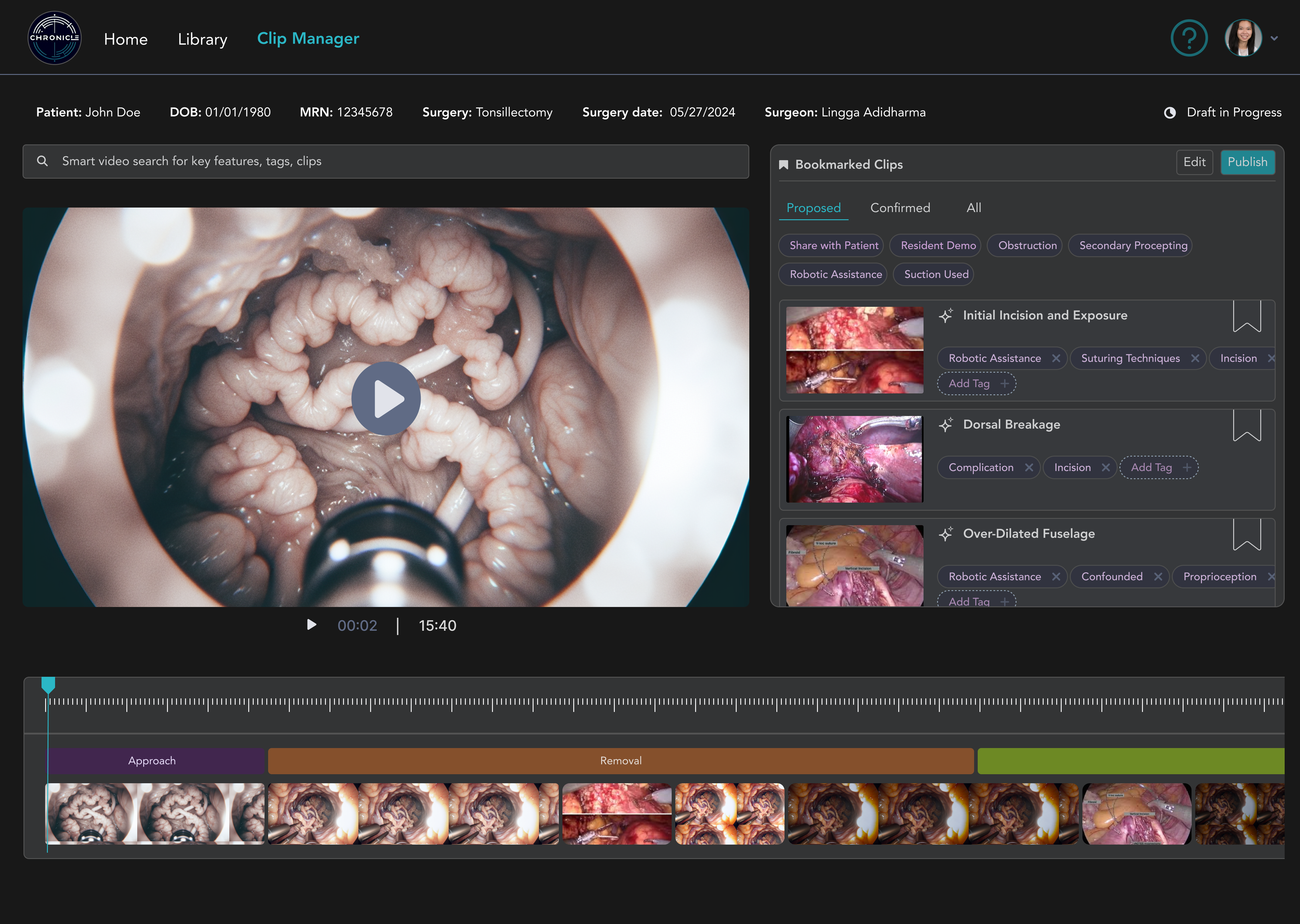
Chronicle surgical AI interface
6 hrs
→ 15 min highlight reel
84%
Algorithm accuracy
0→1
No UI existed before
Award
Brave Award · AI Innovation
The Problem

A powerful algorithm. No way to use it.

Dr. Lingga Adidharma, an otolaryngology surgery resident at UW Medicine, had developed a patent-pending AI algorithm capable of condensing a 6-hour endoscopic surgery video into a 15-minute highlight reel. The algorithm had 84% accuracy, reducing irrelevant scenes to just 1%.

The problem: there was no interface to view or edit the output. Video conversion was done manually with the help of an engineer. We were brought in to build the entire interaction model from scratch.

Our design question: How might digital imagery improve surgeons' recall, collaboration, and time — in order to improve patient outcomes?

The Team

Assembled for depth of expertise.

I put together a senior cross-functional team drawn from Microsoft, Amazon, CrowdStrike, and Alaska Airlines. I led product design end-to-end and was recognized by the judging panel for the visual design.

WS
Warisha Soomro
AT&T
Lead Design
JD
Jenn dela Cruz
UX Manager, Amazon
HL
Helen Ling
Sr. Researcher, Microsoft
AK
Ariel Koh
Sr. Designer, CrowdStrike
JP
Jack Patten
Sr. PM, Alaska Airlines
Discovery

What surgeons actually needed.

Having objective information is much more helpful than subjective information. Go to an art museum — no two people will describe the same painting the same way.

Experienced Surgeon · In-depth Interview

We conducted on-site contextual inquiry at Harborview Hospital, mapping the surgeon's physical workflow. Then we ran 1:1 in-depth interviews with attending surgeons who perform endoscopic procedures. Secondary research covered medical AI literature, HIPAA constraints, and competitive video tools.

01
Accuracy, efficiency, and brevity are constantly competing
Surgeons lose detail when pressed for time. Tasks are largely manual with no digital assistance.
→ Reduce manual effort, increase accuracy
02
Written notes are inherently subjective
Text interpreted inconsistently. Templates bias toward generic descriptions. Images and video are objective.
→ Use imagery to be objective and salient
03
Lack of digital imagery causes repeated procedures
Repeated scans due to unclear documentation. Accurate text may not convey urgency.
→ Add imagery at handoffs and consultations
04
Memory recall is an acknowledged problem
Notes written after the fact — sometimes days later. Multiple similar surgeries blur together.
→ Use wayfinding to aid recall
Design Principles

Five anchors we returned to every week.

01
Efficient and integrated process
Seamlessly integrate into existing workflows. Key tasks should take only minutes.
02
Collaborative and inclusive
Involve surgeons throughout. Recognize generational differences in tool preferences.
03
Utility focus with specific impact
Prioritize functionality over aesthetics. Right multimedia format for each use case.
04
Practical first, speculative second
Ship a basic, quickly deployable UI. Build roadmap for future enhancements — don't delay MVP.
05
Don't put AI on a pedestal
Design as if training a human assistant. Empower surgeons with control. Outcomes, not technology showcase.
Key Decisions

Where judgment calls lived.

Decision 1 — AI Transparency
We designed explicit visual differentiation between AI-generated tags (star icon) and surgeon-created tags (person icon). A confirmation modal before publishing ensures surgeons acknowledge AI-generated content. AI omission is a real risk — the surgeon stays accountable.
Decision 2 — Phase-Aware Timeline
The highlight reel timeline is color-coded by surgical phase (Approach, Removal, Reconstruction). Selecting a clip jumps to that timestamp with phase context — directly addressing the memory recall problem without re-watching footage.
Decision 3 — Proposed / Confirmed / All
The algorithm suggests clips, but surgeons have final authority. The three-tab system gives a clear mental model: what AI recommends, what you've approved, everything. This emerged directly from evaluative testing where the control model was initially unclear.
Decision 4 — Scoping the MVP
The immediate use case is academic and educational — not operative notes — because that's where surgeons get value fastest. EMR integration and patient sharing were roadmapped, deliberately excluded from V1. Clarity over completeness.
The Product

Chronicle — what we shipped.

A web application giving surgeons the ability to view and manage surgical video highlight reels as a supplement to their operative notes.

Highlight Reel Player
Phase-aware video timeline, color-coded by surgical phase. Clicking a clip jumps to that timestamp.
Bookmark Management
Proposed → Confirmed → All tab structure. Surgeons approve AI suggestions or add their own bookmarks.
AI + User Tags
Structured taxonomy for searchable clip organization. Star = AI-generated. Person = surgeon-created.
Smart Search
Search across clips, tags, and phases — within a surgery or across an entire library of recorded procedures.
AI Responsibility Modal
Surgeons must confirm review of all AI-generated content before publishing. Accountability built in.
Publish & Share
Export highlight reels with linked clips for colleagues, residents, and academic use.
Outcome

What we left behind.

Chronicle was recognized with the Brave Award for Innovation in AI at the UW HCDE Capstone. The visual design was specifically called out by the judging panel. The algorithm's patent is pending and the interface is in active development.

Award
Brave Award for Innovation in AI — UW HCDE judging panel
Patent
Provisional filing. Interface in active development.
0→1
No interface existed before this project. Complete interaction model built from scratch.